
 Listicle
Best Neighborhoods to Invest in Portsmouth, Virginia
Last Updated: November 5, 2026
Quick Summary
The best neighborhoods to invest in Portsmouth include Olde Towne and Port Norfolk for appreciation, Churchland for single-family cash flow, and Hidden Cove, Prentis Park, and West Norfolk as emerging options. Each district suits a different strategy, so match the property to your plan before buying.
- Olde Towne's preservation rules limit teardowns and keep housing supply constrained.
- Port Norfolk buyers should price flood insurance into every offer before committing.
- Churchland offers single-family homes with commuter routes toward Suffolk and Chesapeake.
- Gross yield ignores expenses; net yield subtracts taxes, insurance, maintenance, vacancy, and management.
- Verify flood zone, zoning, and rental rules before removing any purchase contingency.
Table of Contents
- Why Portsmouth Neighborhoods Attract Investors Right Now
- How We Evaluated the Best Neighborhoods to Invest in Portsmouth
- Olde Towne: Historic Preservation Meets Steady Demand
- Port Norfolk: Waterfront Views and Long-Term Appreciation
- Churchland: Single-Family Homes With Commuter Access
- Hidden Cove, Prentis Park, and West Norfolk: The Hidden Gems
- Rental Yield vs. Appreciation: Which Strategy Fits Your Portfolio
- How to Build a Real Estate Portfolio Across Portsmouth Neighborhoods
- Real Estate Investment Risk Assessment for Coastal Virginia Properties
- Talk Through Your Portsmouth Investment Strategy With Abrams Realty
- Frequently Asked Questions
Why Portsmouth Neighborhoods Attract Investors Right Now
Portsmouth is one of the rental markets in Hampton Roads that investors watch closely, and understanding its neighborhoods early can help buyers make informed decisions. Buyer interest in the city has often clustered around established, historic districts rather than new construction corridors. Older housing stock in walkable areas can carry different acquisition costs and renter demand than newer subdivisions on the metro's edge, so the tradeoffs are worth comparing.
The city's geography does a lot of the work. Portsmouth faces Norfolk across the Elizabeth River, giving residents quick access to the region's largest employment center through the Downtown and Midtown tunnels. Naval Medical Center Portsmouth and the Norfolk Naval Shipyard in nearby Chesapeake are among the installations that generate military-connected housing demand in the area.
That combination of historic inventory, water access, and military-driven demand is why the best neighborhoods to invest in Portsmouth keep showing up on investor shortlists. Below, this guide breaks down the districts worth a closer look, how to weigh rental yield against appreciation, and where the risks sit for coastal properties.
How We Evaluated the Best Neighborhoods to Invest in Portsmouth
Each neighborhood in this guide was assessed on four factors: housing inventory and price range, rental demand signals, proximity to employment and transit, and exposure to flood risk. Neighborhoods such as Olde Towne, Port Norfolk, and the Churchland area are commonly discussed as established districts, while Hidden Cove, Prentis Park, and West Norfolk are often described as an emerging tier.
The scoring framework below is a starting point, not a verdict. Every investor weighs these factors differently.
| Criterion | What to Check | Why It Matters |
|---|---|---|
| Inventory and price range | Active listings, days on market, condition of housing stock | Determines whether the numbers work at all |
| Rental demand | Vacancy trends, typical lease terms, employer proximity | Drives cash flow between sales |
| Access and transit | Tunnel and bridge routes, commute patterns | Affects tenant retention |
| Flood exposure | FEMA flood maps, insurance quotes | Changes the true cost of ownership |
One caution before proceeding: Portsmouth's housing stock skews older, and deferred maintenance is common. A pre-purchase inspection is not optional here. Skipping a sewer scope on an older home can turn a routine purchase into an expensive repair after closing.
Olde Towne: Historic Preservation Meets Steady Demand
Olde Towne is Portsmouth's oldest residential district, and its restored brick townhomes and waterfront outlook draw buyers who value character over square footage. Historic preservation rules protect the streetscape, which limits teardowns and keeps supply constrained. Constrained supply in a desirable district can support property values over time, though outcomes are not guaranteed.
For investors, the tradeoff is straightforward. Renovation costs run higher because exterior work must meet preservation standards, and older systems need careful inspection. In exchange, the district attracts professionals and long-term renters who want walkability and proximity to the riverfront.
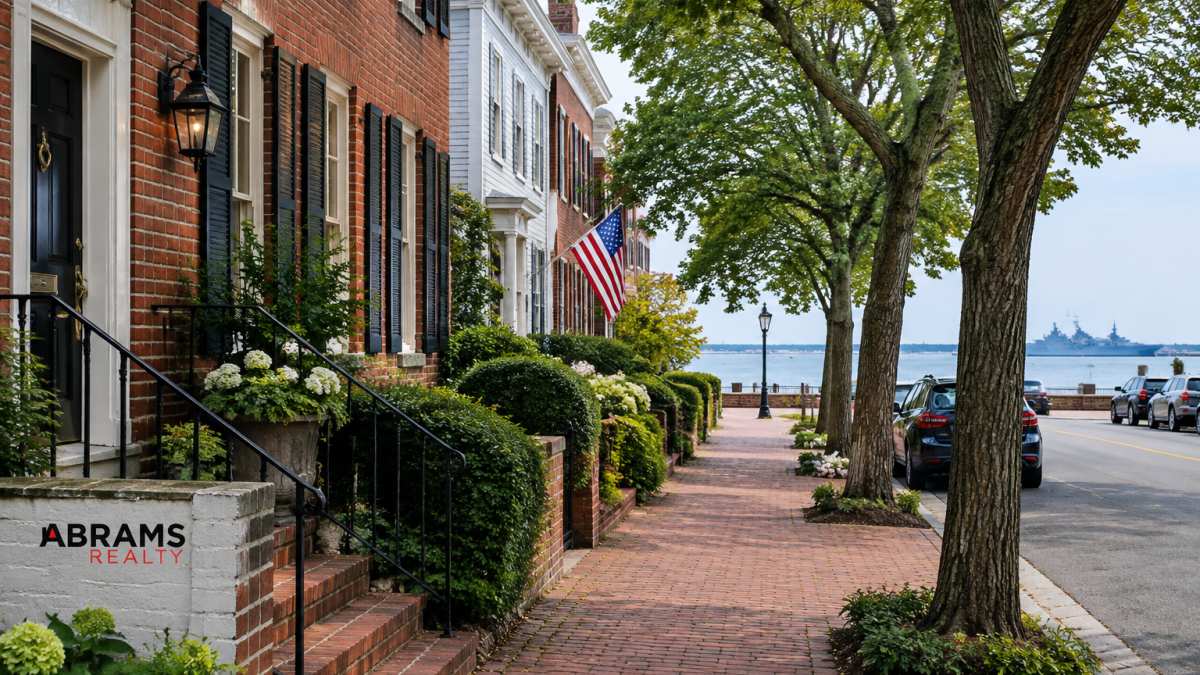
Best for: investors with renovation capacity who plan to hold for appreciation. Skip if: the strategy depends on quick cosmetic flips.
Port Norfolk: Waterfront Views and Long-Term Appreciation
Waterfront views and a working waterfront history define Port Norfolk, a district that has drawn increased investor attention as buyers look beyond the metro's priciest corridors. Homes here sit close to the Elizabeth River, and the neighborhood's older housing stock offers entry points that waterfront districts elsewhere rarely match.
Appreciation is the case here, not immediate yield. Buyers pay for the location premium, and renters in the district tend to be long-tenured. Investors should price flood insurance into every calculation before making an offer, since proximity to the water affects both premiums and lender requirements.
Flood risk can vary block by block, so it is worth checking each address. Two homes a few streets apart can carry different insurance costs depending on their flood zone and elevation. Check the FEMA Flood Map Service Center address by address rather than relying on neighborhood-level assumptions.
Churchland: Single-Family Homes With Commuter Access
Churchland offers a supply of single-family homes with yards and driveways, along with commuter routes west toward Suffolk and south toward Chesapeake. Families and military households relocating to the area often gravitate here because the housing type matches what they need, and the neighborhood sits close to major employment corridors.
Rental arrangements in single-family neighborhoods like Churchland are often longer-term, and investors can compare housing stock across the city when modeling their options.
Property condition still varies widely. Homes built in the mid-twentieth century may have original wiring or plumbing, and those items belong in the acquisition budget, not the surprise column.
Hidden Cove, Prentis Park, and West Norfolk: The Hidden Gems
Hidden Cove, Prentis Park, and West Norfolk are sometimes described as lesser-discussed districts for investors willing to look outside the most-publicized areas. These areas combine lower entry points with proximity to the city's core, and buyers who move early often capture value before broader market attention arrives.
The tradeoff is diligence. "Hidden gem" is a description of pricing and attention, not a guarantee of condition or neighborhood trajectory. Investors should review City of Portsmouth zoning and land-use maps before assuming a property's current use will continue, and should walk the block at different times of day rather than relying on listing photos.
For a deeper neighborhood-by-neighborhood breakdown of these districts, see hidden gem neighborhoods in Portsmouth.
Rental Yield vs. Appreciation: Which Strategy Fits Your Portfolio
Rental yield and appreciation are two different engines, and Portsmouth rewards investors who pick one deliberately rather than chasing both. The problem with most neighborhood guides is that they stop at that sentence. Yield is a calculation, not a vibe, and the calculation is what tells you whether a district fits your strategy.
Start with the two formulas every investor should be able to run in a spreadsheet before touring a property.
- Gross rental yield = annual rent ÷ purchase price. It ignores expenses, which makes it useful only for fast screening between neighborhoods.
- Net rental yield = (annual rent − operating expenses) ÷ total acquisition cost. Operating expenses include property taxes, insurance, maintenance, vacancy allowance, and property management, but not the mortgage payment.
A common pattern in older coastal markets is that gross yield looks acceptable on paper and net yield collapses once flood insurance, older-building maintenance, and vacancy are loaded in. That gap is the single most important number in a Portsmouth acquisition.
A hypothetical worked example
Assume a hypothetical single-family rental purchased for $250,000 with monthly rent of $1,900. That is $22,800 in annual rent, or a gross yield of about 9.1%. Now subtract illustrative annual operating costs: property taxes, landlord insurance including flood coverage where required, a maintenance reserve, a vacancy allowance of roughly one month per year, and property management. If those operating costs total about $9,000, net operating income is roughly $13,800, and net yield on the purchase price is about 5.5%. The mortgage payment comes out of that $13,800, not out of the gross rent. These figures are illustrative only, your taxes, insurance quotes, and rent estimates will differ by address, and none of this is a projection of your return. Effective oversight of these ongoing expenses often depends on selecting a reliable Hampton Roads property management partner to handle the day-to-day demands of your investment.
Run that same exercise on two or three candidate properties in different districts and the neighborhood choice often makes itself.
How the two strategies actually differ
| Strategy | Typical Neighborhood Fit | What You Are Buying | Main Risk |
|---|---|---|---|
| Cash flow first | Churchland, West Norfolk | Monthly income with margin after expenses | Slower value growth; heavier maintenance on older stock |
| Appreciation first | Olde Towne, Port Norfolk | Constrained supply and location premium | Thin or negative current yield; carrying costs during hold |
| Balanced | Prentis Park, Hidden Cove | Moderate performance on both measures | Requires disciplined deal selection; easy to overpay |
A yield-focused buyer should underwrite to a vacancy allowance and a repair reserve rather than a best-case rent roll. An appreciation-focused buyer should be honest about how many years of negative or break-even cash flow the portfolio can absorb, because constrained-supply districts rarely cash flow at purchase.
Watch out: mixing the two strategies in one property, paying an appreciation-district price while underwriting cash-flow rents, is the most common way a Portsmouth deal fails on paper before it ever fails in practice.
The tax piece most guides skip
Property tax burden is a real yield input, and it is assessed at the locality level, not the neighborhood level. Property assessments and tax rates are set at the locality level, so investors should confirm the current figures with the City of Portsmouth. Because assessments are periodic and the rate is set annually, an investor should confirm the current rate and the property's assessment through the City of Portsmouth Commissioner of the Revenue rather than relying on a listing's stated tax figure, which may reflect a prior assessment or a different exemption status. Some localities offer real estate tax relief programs for qualifying homeowners, and eligibility rules vary, so verify any relief with the city before building it into a projection.
For a broader set of approaches, see proven real estate investment strategies.
How to Build a Real Estate Portfolio Across Portsmouth Neighborhoods
Building a portfolio across Portsmouth works best in stages, and the sequence matters more than the speed. A common approach is to acquire one property in a cash-flow neighborhood first, stabilize it, and use the documented income to support financing for a second acquisition in an appreciation-oriented district.
Practical steps that hold up in this market:
- Verify the property's flood zone and get an insurance quote before making an offer
- Budget for a full inspection, including sewer scope and electrical panel review
- Confirm current zoning and any planned infrastructure work nearby
- Model carrying costs with a vacancy allowance, not a best-case scenario
- Document rent history and expenses from day one to support future financing
Hidden repair costs are the most common portfolio killer. A roof, HVAC system, or foundation issue discovered after closing can wipe out a year of projected cash flow. Reviewing how to avoid hidden home repair costs before each acquisition is worth the time.
Real Estate Investment Risk Assessment for Coastal Virginia Properties
Coastal Virginia properties carry risks inland properties do not, and a realistic assessment starts with water. Flood exposure, wind insurance, and the condition of older building systems are the three variables that most often change an investor's numbers after the fact. But the risk that most often changes an investor's strategy is regulatory, and it is the one most neighborhood guides never explain.
The water and building checklist
- Pull the FEMA flood map for the exact address and note the zone, not the neighborhood average.
- Obtain insurance quotes, including flood coverage, before removing contingencies.
- Inspect the roof, drainage, and foundation for water intrusion history.
- Review the property's permit history with the city.
- Confirm the current rental regulations that apply to the property type and the intended lease term.
That fifth step is where Portsmouth investors get surprised, so it deserves its own treatment.
Short-term vs. long-term rental rules: the gap most guides miss
Short-term rental rules in Virginia are set largely at the locality level, and investors should confirm the current requirements with the city before relying on short-term income. That means the rules that govern a Portsmouth property come from the City of Portsmouth, not from a generic state rule, and they can differ from the rules in neighboring Norfolk, Chesapeake, or Virginia Beach.
In practice, a Portsmouth investor weighing short-term rental potential should verify, through the city:
- Whether a short-term rental permit, registration, or business license is required, and what the application requires.
- Whether the property must be the operator's primary residence, which would rule out a pure investment property.
- Occupancy limits, parking requirements, and any spacing or density limits between permitted rentals.
- Whether the property owners' association or condominium documents impose additional restrictions, these are private rules the city does not enforce but that can still prohibit the use.
Long-term rentals carry their own regulatory layer. Virginia's landlord-tenant law sets baseline obligations for many residential rentals, and its applicability depends on the property and arrangement, so owners should verify which rules apply to them. Screening, assistance animals, occupancy limits, and source-of-funds rules are governed by a combination of federal Fair Housing law and Virginia law, and those rules change. An investor should verify current requirements through the Code of Virginia and the city before underwriting a rental strategy, and should treat any unresolved legal question as a reason to get qualified guidance rather than to assume.
Watch out: underwriting a property on short-term rental income before confirming the city permit and any association restriction is the fastest way to buy a property whose highest-and-best use is legally unavailable to you.
Flood insurance is a financing risk, not just a cost risk
Flood exposure affects more than the premium line. Lenders on properties in certain flood hazard areas may require flood insurance as a condition of the loan, and coverage costs can vary by location and property characteristics. Two homes a few streets apart in Port Norfolk can carry meaningfully different insurance costs and different lender requirements. Check the FEMA Flood Map Service Center address by address, and get quotes before you make an offer rather than after.
For flood-zone considerations specific to the region, flood zone guidance for Norfolk buyers covers the questions Portsmouth investors also need answered.
Talk Through Your Portsmouth Investment Strategy With Abrams Realty
Portsmouth rewards investors who do the neighborhood-level work: flood maps checked, inspections scheduled, zoning confirmed, and a clear decision about whether yield or appreciation drives the purchase. The districts in this guide can serve different strategies, and matching the property to the plan matters more than chasing the lowest listing price.
Abrams Realty offers services for buyers, sellers, and property owners across the Virginia Beach and Hampton Roads area, including property management support for owners who would prefer not to handle tenants themselves. If you are weighing whether to hold or sell a property you already own, a Rental Market Analysis and the Rent Vs Sell Calculator can put real numbers behind that decision. The property search tools and community guide are available to help readers follow listings and local market trends.
To discuss a specific acquisition or review an existing portfolio, readers can connect with Liz Abrams and the Abrams Realty team directly.
Frequently Asked Questions
What are the primary economic drivers behind Portsmouth neighborhoods?
Portsmouth's economy leans on the shipyard and maritime industry, the Port of Virginia's nearby cargo operations, and a steady stream of military-connected households tied to installations across Hampton Roads. That mix supports rental demand in neighborhoods close to employment centers, including Olde Towne and Port Norfolk. Investors should confirm current employment and development figures with the City of Portsmouth before committing capital.
How does proximity to military installations affect rental demand in Portsmouth neighborhoods?
Military households rotate through Hampton Roads on PCS orders, which creates consistent demand for rental housing near the region's installations. That turnover can shorten vacancy periods, but it also means tenants often leave on fixed timelines. Investors should budget for more frequent turnover costs and verify current VA loan occupancy rules on VA.gov if they plan to house-hack. Abrams Realty's military relocation team works with PCS households regularly and can speak to what renters in this segment look for.
How do I research zoning and land use in Portsmouth before buying an investment property?
Start with the City of Portsmouth's official website, which publishes zoning maps, land-use designations, and planning department resources. Confirm the current zoning for any parcel you are considering and ask whether short-term rentals are permitted in that district, since rules vary by locality. A real estate investment risk assessment should include this step before you make an offer. Abrams Realty can help you interpret what the zoning means for a specific property's rental strategy.
What tax implications should real estate investors know about in Virginia?
Virginia investors should understand local property tax assessments, which the City of Portsmouth publishes, and how reassessments affect cash flow over time. Federal capital gains treatment on investment property sales and depreciation rules also shape returns, and Confirm details with a qualified tax professional, since your circumstances matter. The CFPB's mortgage tools can help you model financing costs before you finalize a purchase.
Should I choose rental yield or appreciation when comparing Portsmouth neighborhoods?
It depends on your timeline and cash needs. Waterfront and historic districts like Olde Towne and Port Norfolk may suit buyers focused on appreciation who can hold through market cycles, while other districts may suit buyers focused on cash flow. Outcomes depend on the specific property. Many investors blend both. Run the numbers for each property, including property taxes, insurance, and flood coverage, before deciding which Portsmouth neighborhood fits your portfolio.
Portsmouth's historic districts and emerging neighborhoods offer real opportunities, but only for investors who underwrite carefully and verify what they are buying. Abrams Realty can help with local market analysis, property search through direct MLS updates, and professional management for rental portfolios. Get started with Abrams Realty and build a Portsmouth investment plan grounded in the actual numbers.